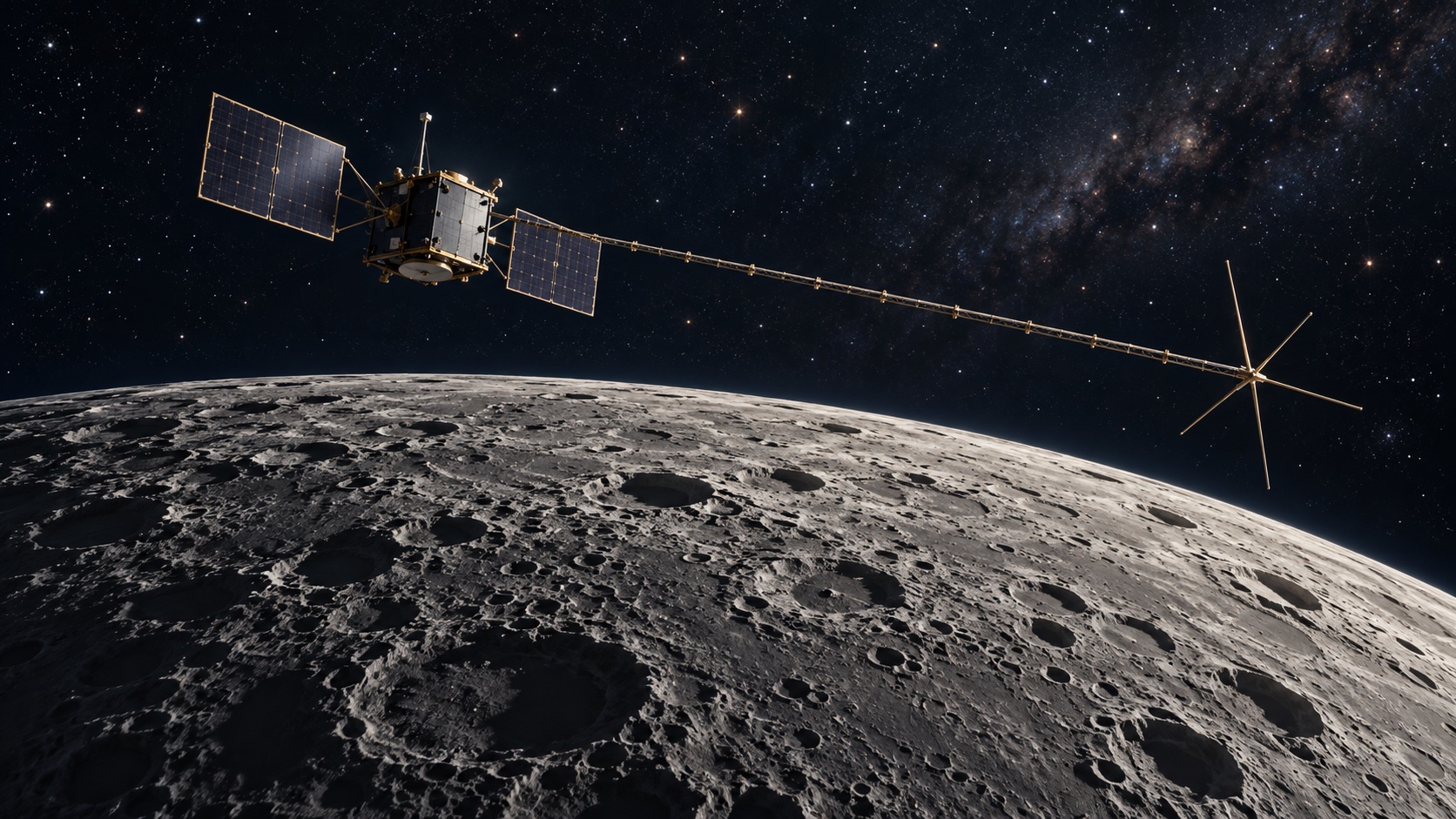
Cambridge-led researchers are developing CosmoCube, a proposed small satellite that would observe low-frequency radio signals while the Moon shields it from interference originating on Earth. The university’s August 14 report describes an instrument intended to study redshifted hydrogen emission from the early universe.
The concept combines a compact radio instrument with calibration references to distinguish faint signals from changes in its own electronics. Laboratory prototypes and environmental testing were underway when the report appeared. CosmoCube had not launched; the team’s hope for a launch within five years was an ambition, not a confirmed flight schedule. Renewed coverage does not change the original research date.
NAOAT analysis: The spacecraft must be quiet as well as small
A sensitive space instrument needs more than a favorable observing location. Its power electronics, thermal behavior and onboard communications can affect the measurement. A compact design therefore needs an equally careful account of which subsystems operate during observation and how their effects are measured.
Calibration deserves attention early in a mission review. Reference measurements help reveal drift, but the team must still determine how faithfully those references represent the observing conditions. Ground tests and simulations should connect to a plan for checking instrument behavior after launch, when physical access is no longer possible.
There is also a scheduling problem to solve. The conditions that create a quiet observing window can differ from those that support communication with Earth. Data storage, power allocation and transmission windows need to work together so that a promising instrument can return a usable record over the mission.
For small-spacecraft developers, the wider lesson is to evaluate the complete measurement chain. Reducing platform size can create useful options, but it does not remove the need for thermal testing, calibration and a credible operations plan. The strongest next evidence would be documented instrument performance under representative conditions, followed by a funded and clearly defined flight opportunity.