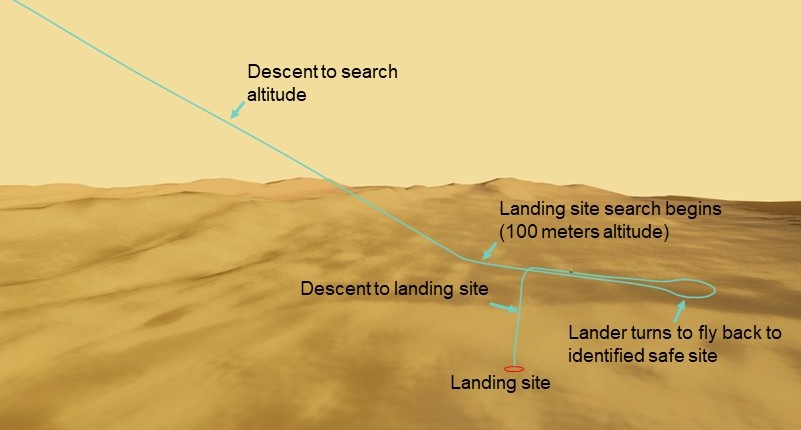
NASA’s October 23 Dragonfly update reports a real-time simulation of the rotorcraft’s initial flight at Titan, run on flight-like avionics at Johns Hopkins Applied Physics Laboratory. The test combined flight software with simulated navigation-camera, inertial and lidar inputs. It was a ground test, not a flight on Titan.
The sequence included searching for a landing location and returning to it for descent. NASA says testing on the actual flight system, additional flight profiles and deliberate fault injection are still ahead. The mission is scheduled to launch no earlier than 2028 and reach Titan in 2034.
NAOAT analysis
A navigation demonstration becomes more informative when the calculations must finish on the schedule required by the vehicle. A visually convincing trajectory alone cannot show whether a landing decision arrived soon enough for the controller to act. Running connected components together exposes a different class of question from checking each algorithm in isolation.
For engineers developing autonomous machines closer to home, the useful comparison is between the test environment and the intended operating environment. Which components are production hardware? Which measurements are synthesized? What variation has been introduced into those measurements? Those answers define what a successful run actually establishes and where additional evidence is needed.
A test record should also preserve the unsuccessful cases. A controller that completes a planned route may still need improvement in deciding when to abandon it. Engineers can use scenarios with conflicting inputs or unavailable measurements to examine whether the system recognizes its limits and reaches a defined fallback state. Such testing turns an autonomy claim into observable behavior. The practical milestone is a traceable chain from sensing to decision to action, with the assumptions behind that chain remaining visible as hardware and software mature.