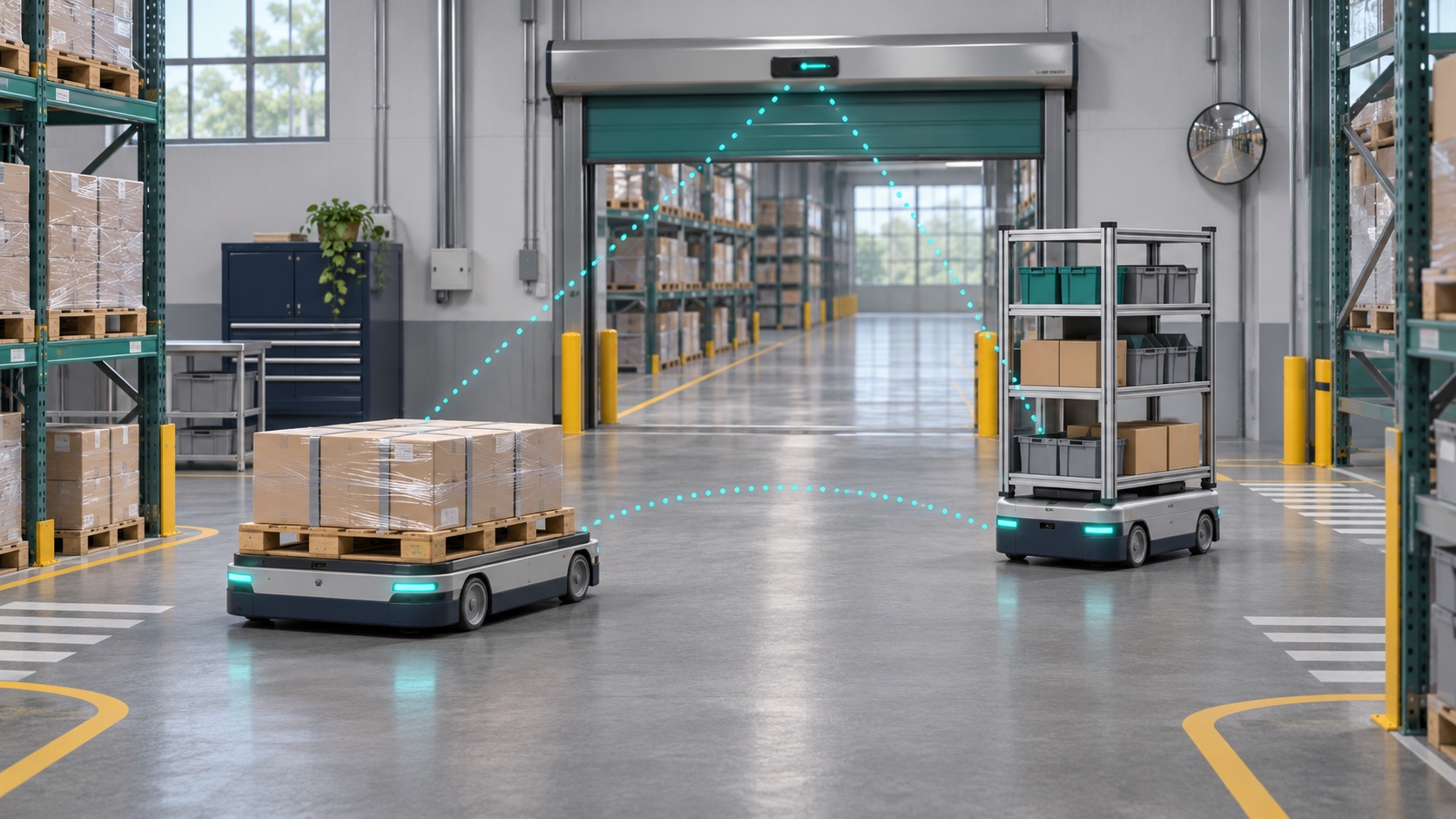
The Association for Advancing Automation announced ISO 21423:2026 on November 2, giving industrial mobile robots and their fleet managers a common basis for exchanging operational information across vendors. The standard was developed by ISO Technical Committee 299.
A3 says the communication model covers location, speed, direction, condition, tasking and availability, as well as requests for actions. It extends beyond robot-to-robot messages to equipment and building systems, including automated doors, lifts and alarms, and to enterprise software.
The published scope makes an important boundary explicit: this is not a safety standard and it does not specify navigation requirements. It addresses shared industrial workplaces; consumer, entertainment, medical, military and public-road applications are excluded.
A3 expects common communication to improve coexistence and supplier choice. Those are anticipated benefits of adoption. Publication of the document does not establish that a particular mixed fleet has implemented it or demonstrated reliable operation together.
NAOAT analysis
A warehouse may buy different machines because their loads, dimensions or jobs differ. The communication problem appears when those machines share resources: a doorway, an aisle or a workstation. A common description of what each robot is doing can reduce the amount of translation required between systems.
But receiving another machine’s position does not determine what to do about it. The distinction between communication and navigation leaves room for competing fleet-control approaches while preserving a shared vocabulary. It also prevents a messaging claim from being mistaken for evidence about collision avoidance.
The standard’s commercial significance will depend on implementations and integration evidence. Buyers gain a more specific basis for discussing compatibility, but the useful outcome remains an operating system of robots, infrastructure and software. A standards reference alone cannot establish that the complete installation works.