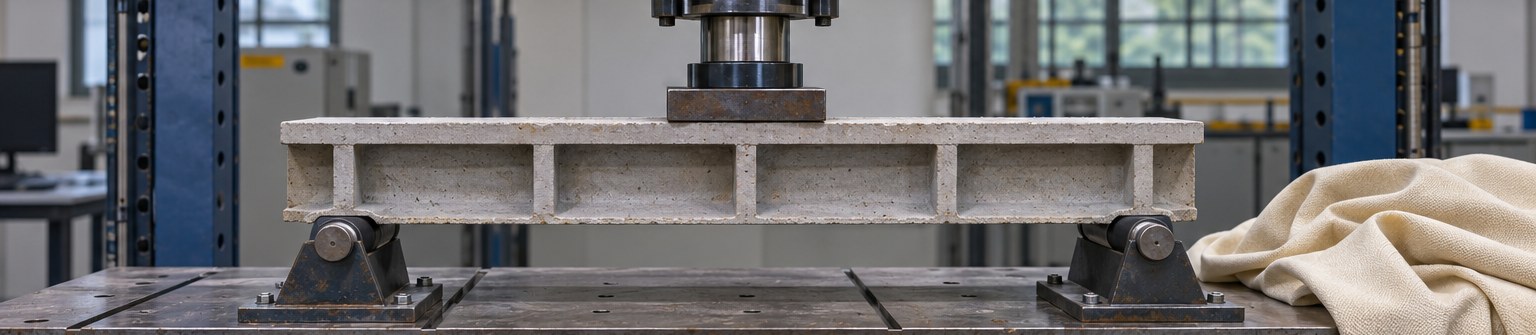
Thirty-six buckets of water supplied the load for an unusual concrete beam test at MIT. A team led by Mark Hellrich cast a three-meter span in a fabric mold sewn from flat panels. Loaded to roughly 30 percent of its design load, the beam deflected at its midpoint within about 2 percent of the predicted movement. The experiment measured behavior under ordinary service conditions. Ultimate strength remains a separate question.
The shape puts concrete where it takes compression and gives the reinforcing steel a path through the beam to carry tension. Against a conventional beam designed for the same load, the team estimated its design used about a third as much concrete and half as much reinforcing steel. Realizing those savings meant translating the designed shape into cloth that would sag under the weight of the wet mix.
The researchers compared molds sewn from 36, 56 and 76 panels. Smaller panels improved control over individual details, but every extra seam also introduced another opportunity for a cutting or stitching error. Scans showed the middle option gave the best overall compromise. The team’s cost estimates likewise changed direction with local wages: sewing time could erase the savings on concrete and steel.
The price of a seam
For a builder weighing a one-off component, the purchased material is only one side of the estimate. The person assembling the mold must reproduce the intended geometry before concrete ever reaches the site. A production run would change that calculation again. Repetition could improve assembly time, while a rigid mold reusable across several pours would also spread its tooling cost. The prototype makes the labor on each side of that comparison visible.