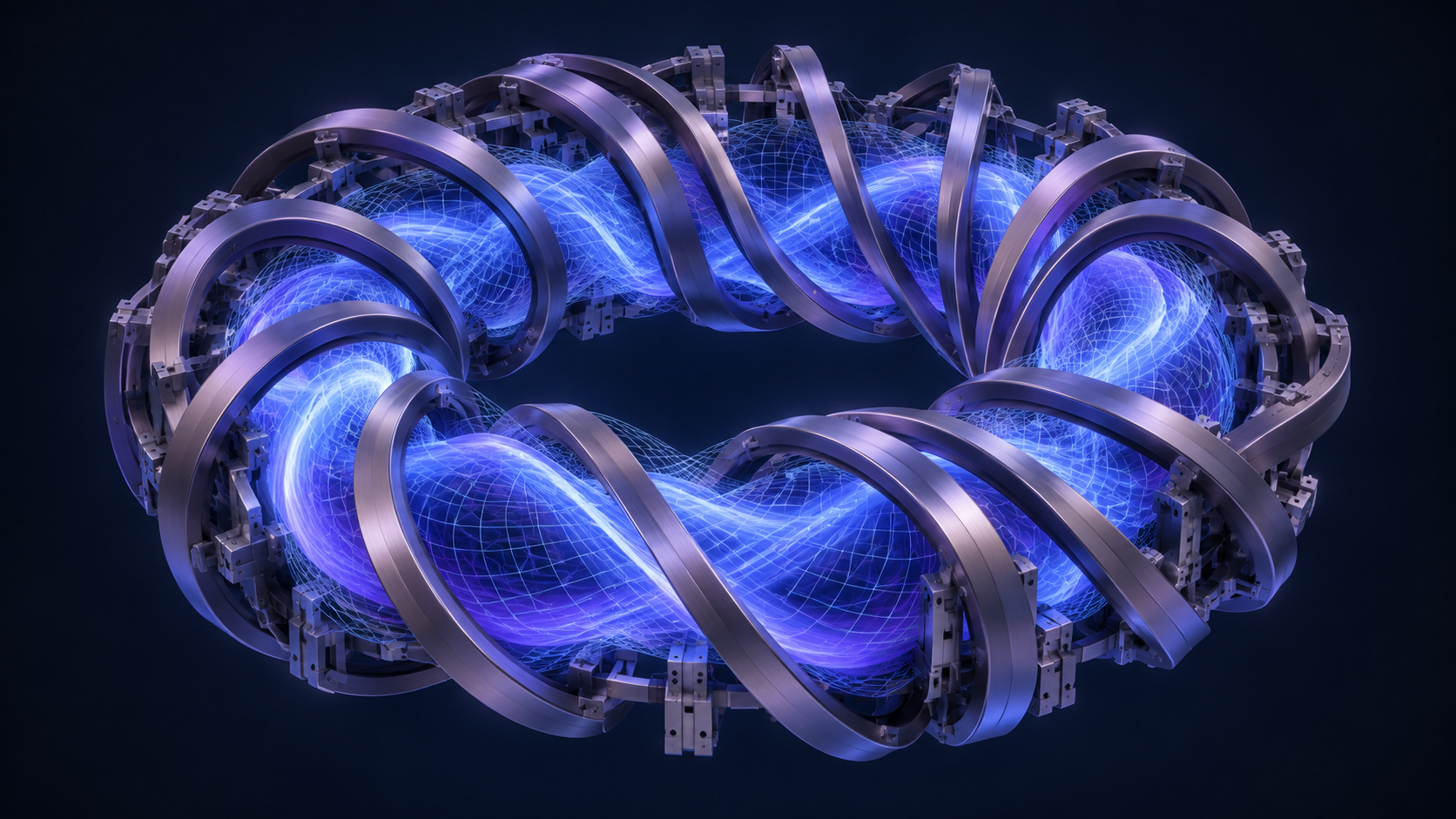
UT Austin reported October 16 that a team led by Joshua Burby will receive three years of Google.org support to develop AI models for fusion research. Collaborators include the University of Washington and New York University. The project targets stellarators, whose complicated magnetic configurations make repeated simulations expensive.
An expanded October 14 Oden Institute report describes neural surrogate models for compact, high-beta designs, where plasma pressure strongly affects the magnetic configuration. The aim is to accelerate coupled design calculations and explore more candidates. These are research goals, not reported speedups, construction-cost reductions, or a demonstrated electricity-producing reactor.
NAOAT analysis
The important benchmark is whether faster calculations lead researchers toward designs that remain promising under more detailed examination. A surrogate can produce answers quickly while making its largest errors precisely where an optimizer searches for an apparent advantage. That makes the quality of selected candidates more informative than average prediction error alone.
A proposed evaluation could give two design searches the same computing budget, with one using the surrogate and one using the established calculation workflow. Both would then submit their strongest candidates to the same high-fidelity solver. The comparison would ask how many viable candidates survive, not merely how many calculations each method performs.
Another useful test would deliberately include configurations outside the training set’s familiar range. A model that recognizes its uncertainty could request an expensive calculation there rather than confidently rank an unsupported design. The resulting calculation could become new training evidence, concentrating resources where the design decision is most sensitive.
For energy researchers, this is a practical way to frame the value of scientific AI: reducing the cost of exploring alternatives while preserving a demanding final verification step. Even a successful computational result would leave other engineering and economic questions for reactor development. The project’s immediate contribution should be judged at the design-search level before extending claims to a future power plant.