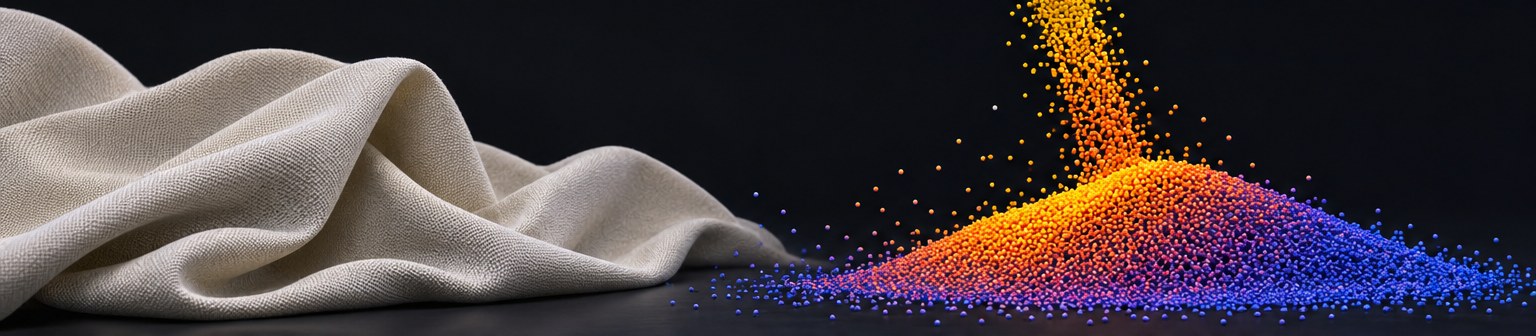
When cloth twists, neighboring points stay connected. Sand grains in a collapsing pile can slide past one another and acquire entirely new neighbors. A research team involving MIT and the University of British Columbia used a shared computing architecture to simulate both kinds of motion. MIT described the work November 9 ahead of SIGGRAPH Asia. The authors first posted their paper in May.
WorldParticle describes material as points that carry information about their position and motion. It handles known external forces explicitly, then uses a learned correction to estimate what happens to the points. Grouping points together during part of the calculation lets the model represent interactions across a scene without carrying every local detail through each stage. It restores individual motion when producing the next frame.
In one cloth test the researchers applied twisting forces beyond those used for training. They report that the simulation stayed stable for 250 frames, compared with a training horizon of 200. Another demonstration changed the shape of a fluid container and the quantity of liquid. These are different tests of transfer: one changes the forcing and duration, the other changes the scene itself.
What a shared simulator changes
For a group comparing design options, a common simulation architecture could make it easier to reuse the same computing tools across projects. Accuracy would still have to be judged against the specific decision. A cloth animation may stay stable while predicting the wrong amount of stretch. A container design may depend on where a liquid first crosses its rim. Those questions call for measurements tied to the material and geometry, even when the software handling them is shared.