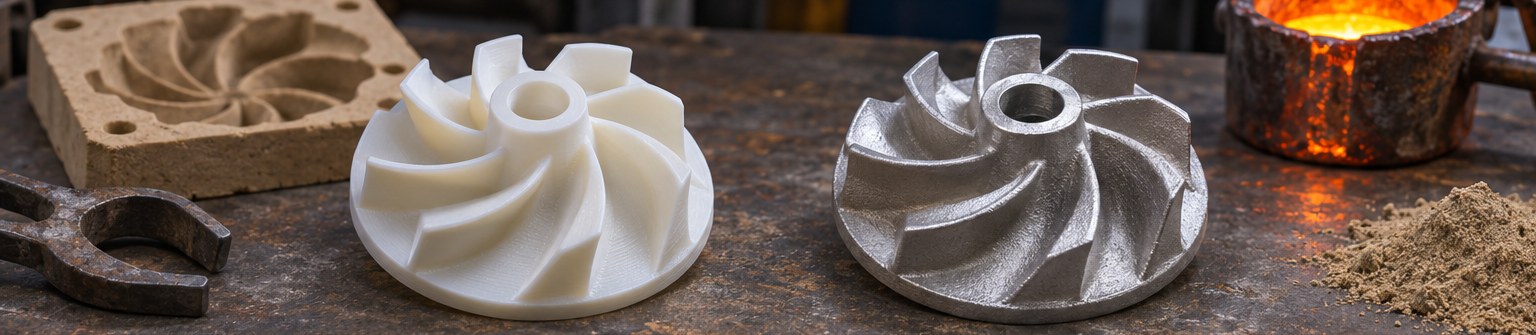
Fabri’s Massachusetts foundry is using a printer to change the economics of a part that ultimately comes out of a pour. The printer makes the expendable pattern, rather than the metal component. That distinction matters when an engineer sees the first casting and wants a different one.
MIT News reports that Fabri moved production to a 16,000-square-foot plant in Billerica this spring after opening its first foundry in Ashland in 2025. Software translates a customer’s design into a resin pattern. A ceramic shell built around that pattern subsequently gives the poured metal its shape. Revising the digital design avoids committing to new hard tooling for each change.
Co-founder Steven Davis told MIT that a finished part can take as little as a week from receipt of a design. That is a best-case timeline. The company already produces castings in several metals but is still working through qualification for critical aerospace applications. A larger facility remains a plan for 2027.
What the first casting can tell a buyer
For a customer trying to understand why an early design failed, the value of a faster casting is an earlier decision. The team can examine a physical part while it can still afford to move a feature or reconsider a material. The business case looks different for an unchanged part already made in volume with tooling that has paid for itself.
A first article and a repeat order also answer different questions. One shows what a design can look like in metal. A series made to the same specification shows whether its dimensions and material properties hold across production. Cutting the wait for the first result gives a buyer more time to collect the second kind of evidence.