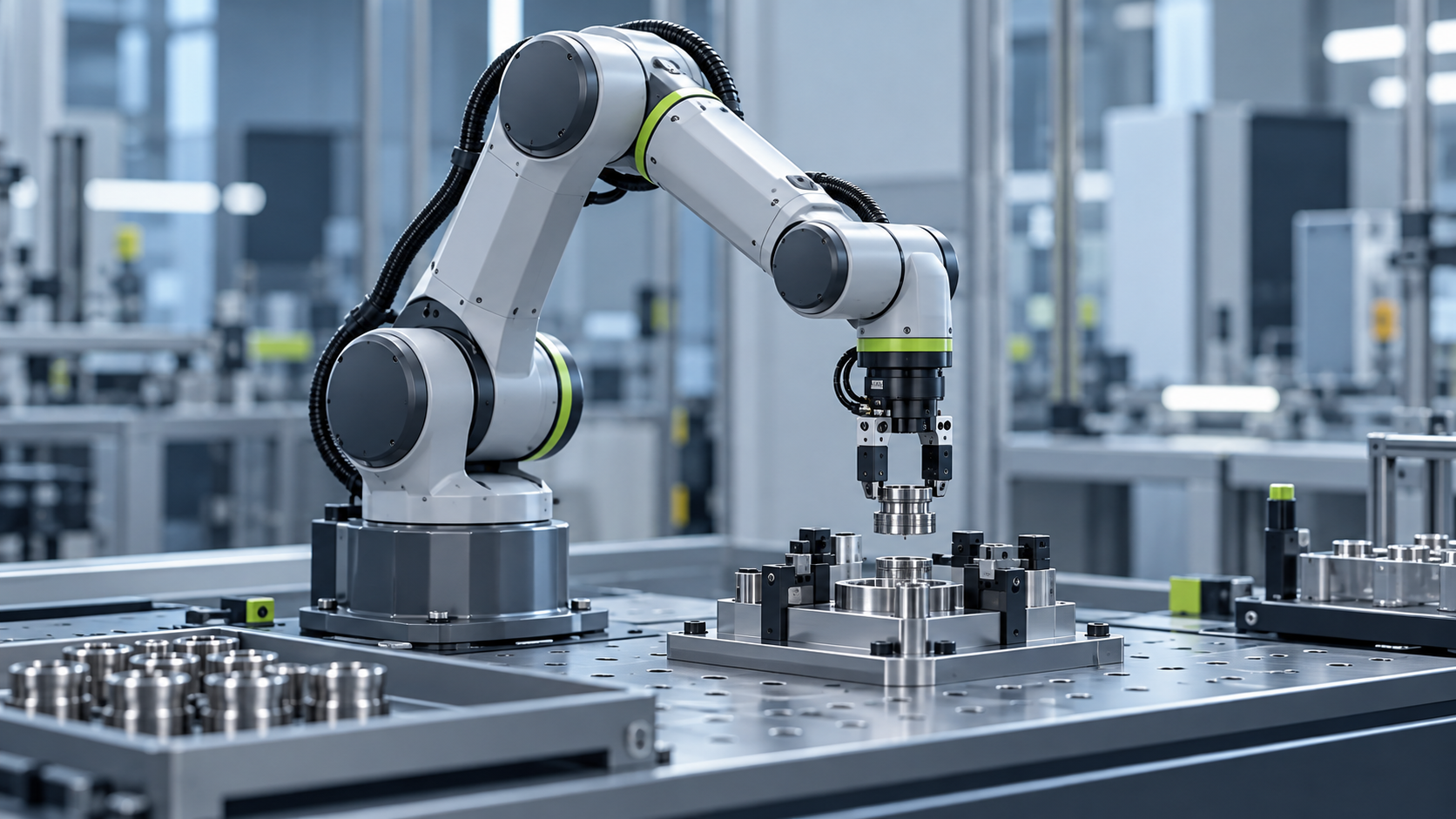
ABB introduced the IRB 1700 and IRB 1700ID on October 12. The family comprises five variants with payloads from 6 to 12 kilograms and uses OmniCore controllers. The ID model routes cables and hoses through the arm, a design intended to simplify installation.
ABB claims cycle times up to 20 percent shorter than comparable robots and power consumption up to 15 percent lower than its predecessor. The power comparison uses the IRB 1600 with the same payload on OmniCore. These are manufacturer figures, not independently verified production results, and individual specifications should be checked against the selected variant.
NAOAT analysis
For a compact manufacturing cell, the robot’s nominal footprint is only part of the space calculation. The fixture, tool, incoming parts, cable motion, and maintenance access determine whether an installation actually fits. A smaller base can have limited value if the chosen gripper or service clearance becomes the dominant constraint.
An integrator evaluating the new family could therefore start with a complete task model rather than the fastest advertised movement. The test should include approach paths, tool orientation, part presentation, and the time needed for the process itself. In welding or finishing, reducing travel time may leave the process interval unchanged, so the improvement in completed parts can differ from the improvement in robot motion.
The energy comparison similarly benefits from a production denominator. Measuring energy per accepted part would account for idle time, peripheral equipment, and rework. A lower robot power figure alone cannot establish the electricity savings for a full cell. This is a proposed evaluation method, not an additional result in ABB’s announcement.
Internal cable routing introduces a useful maintenance question as well: how easily can the actual tool package be installed, inspected, and replaced? Demonstrating that procedure with the intended equipment would help a buyer judge the tradeoff between tidy packaging and service access. The strongest hardware comparison combines production performance with the practical work required to keep the cell running.