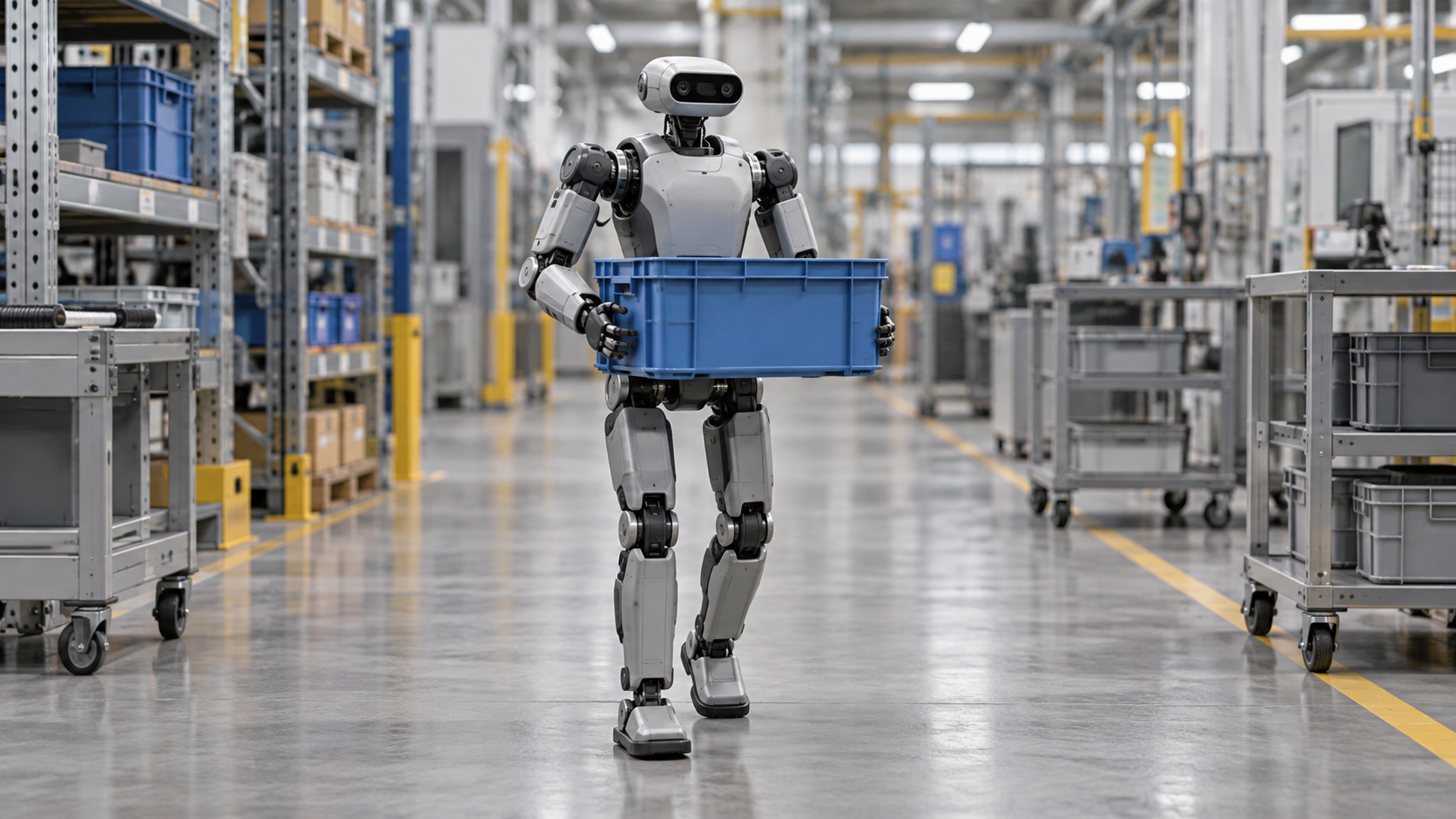
Generative Bionics announced on October 21 that it plans a 5,000-square-metre Physical AI Data Factory in Italy, targeting operation in the fourth quarter of 2027. It envisions two further sites, one elsewhere in Europe and one serving global markets. AMD Helios infrastructure is planned for the network.
The company says GENE.01 robots would perform industrial tasks, with those environments recreated in simulation. Models would return to physical robots for validation before customer deployment. This is a development plan, not evidence that the proposed facilities are operating or that industrial reliability has been established.
NAOAT analysis
The useful question for a prospective factory customer is what the training environment leaves out. A demonstration aisle can reproduce shelf dimensions while missing a worn floor, a changed container or an interruption during a shift. A validation program becomes more informative when it documents these differences and explains which conditions the robot has actually encountered.
Simulation should also have a visible boundary. Teams could keep a record of the physical observations used to build each virtual environment, then reserve unfamiliar conditions for separate testing. Otherwise, generating many variations may create an impressive quantity of data without showing whether the model handles a genuinely new situation. The number of simulated trials alone would be an incomplete purchasing criterion.
Before a pilot, an operations team could define a short acceptance sheet covering completed tasks, interventions, recovery time and damage. The same definitions should apply in the training facility and at the customer site. That would make the handover a comparison between two measured operating environments, rather than a move from a polished demonstration to an open-ended experiment on a production line.