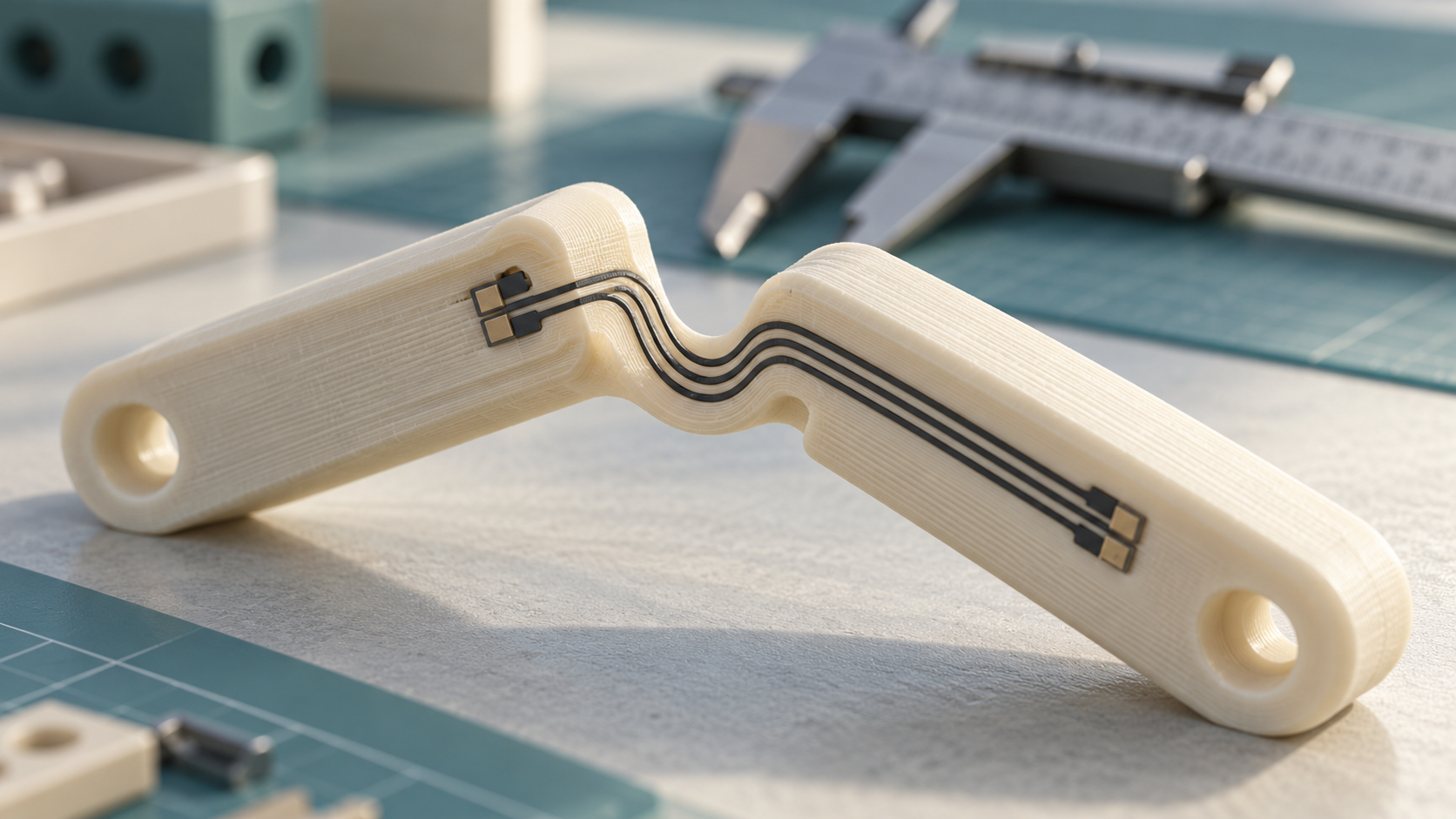
MIT and Tianjin University researchers have developed X-Hinges, software for designing 3D-printed mechanisms with embedded motion sensing. MIT’s October 22 account describes separate conductive materials for sensors and interconnecting traces, reducing interference between their signals. Users select shapes and movement directions, and the tool places sensing elements at the bends.
Demonstrations include a glove that transfers finger movements to a robotic hand and a lamp that changes brightness when compressed. Printed copies still differ electrically, requiring calibration; the researchers developed a camera-based method to align their readings. The work is scheduled for presentation at the ACM Symposium on User Interface Software and Technology in early November.
NAOAT analysis
The useful design shift is that movement and measurement can be considered together. A product designer could ask where a joint should flex and what that movement needs to communicate in the same design review. That is more concrete than describing an object as self-aware: the engineering question is whether a measurable physical change produces a dependable signal.
For a workplace prototype, calibration deserves its own acceptance step. Two externally identical parts should not be assumed interchangeable until the same movement produces comparable readings. A practical trial could record several known positions, repeat them after cycling the joint and check whether the resulting signals remain distinguishable. Those measurements would help separate a promising demonstration from a repeatable input device.
There is also a maintenance question worth answering before a pilot expands: what happens when the flexible part is replaced? Keeping the printed geometry, material settings and calibration record together would make the replacement process easier to evaluate. The value of embedded sensing will depend partly on how predictably teams can reproduce and service it.